About

Engineering isn’t the bottleneck anymore. AI-driven development lets you ship code incredibly fast. The real risk is the high‑speed gap where code passes tests but fails business outcomes.
BaseRock Agentic QA platform brings Business Use Case Testing (BUCT): an AI‑driven control layer that continuously validates your revenue and customer‑critical flows while also auto‑maintaining the integration and contract tests underneath without manually writing test script.
How Baserock Works
The diagram above illustrates how BaseRock connects your existing inputs to actionable QA outputs through three distinct zones.
Zone 1 — Your Inputs
BaseRock works with two types of inputs that you already have:
Codebase Connect any Git repository — Java, Python, Go, or any language. BaseRock reads your source code directly to understand what every API endpoint does, requiring zero manual configuration or spec files.
Requirements Import your existing PRDs, Jira tickets, API docs, or plain-text domain rules. These define what "correct" means from a business perspective, going beyond whether code simply compiles or returns a 200 response.
Zone 2 — The BaseRock Platform
Once your inputs are connected, the platform processes them through four coordinated components:
Discovery Engine Automatically scans your source code to extract every API endpoint, its schema, request/response shapes, and cross-service dependencies. No manual spec files or annotations are needed — the engine builds a live map of your API surface from the code itself.
BUCT Layer (Business Use Case Testing) Reads your PRDs and Jira tickets to derive end-to-end business flows such as signup, billing, and renewals. The BUCT layer keeps these flows continuously in sync with how the code actually behaves, so drift between requirements and reality is caught automatically.
AI Generator The LLM-powered core of the platform. It combines endpoint knowledge from the Discovery Engine with business flows from the BUCT Layer to generate comprehensive test cases, executable playbooks, and edge-case scenarios. The AI Generator supports Anthropic, OpenAI, Vertex AI, and AWS Bedrock — you bring your own LLM key.
BaseRock Agent Deployed inside your own environment, behind your firewall. The agent receives test instructions from the Control Plane, executes playbooks against your live services, and streams pass/fail results back in real time. Because it runs in your environment, no production traffic or sensitive data ever leaves your network.
Zone 3 — Your Outputs
The platform produces two categories of output:
Test Suite Auto-generated test suites with executable playbooks that are ready for your CI/CD pipeline. These cover functional tests, contract tests, and edge cases — without writing a single line of test code.
Business Reports Reports that verify whether your code fulfils actual business outcomes, not just technical correctness. The reports flag when a flow "works technically" but fails the expected business result, giving engineering and product teams a shared view of system health.
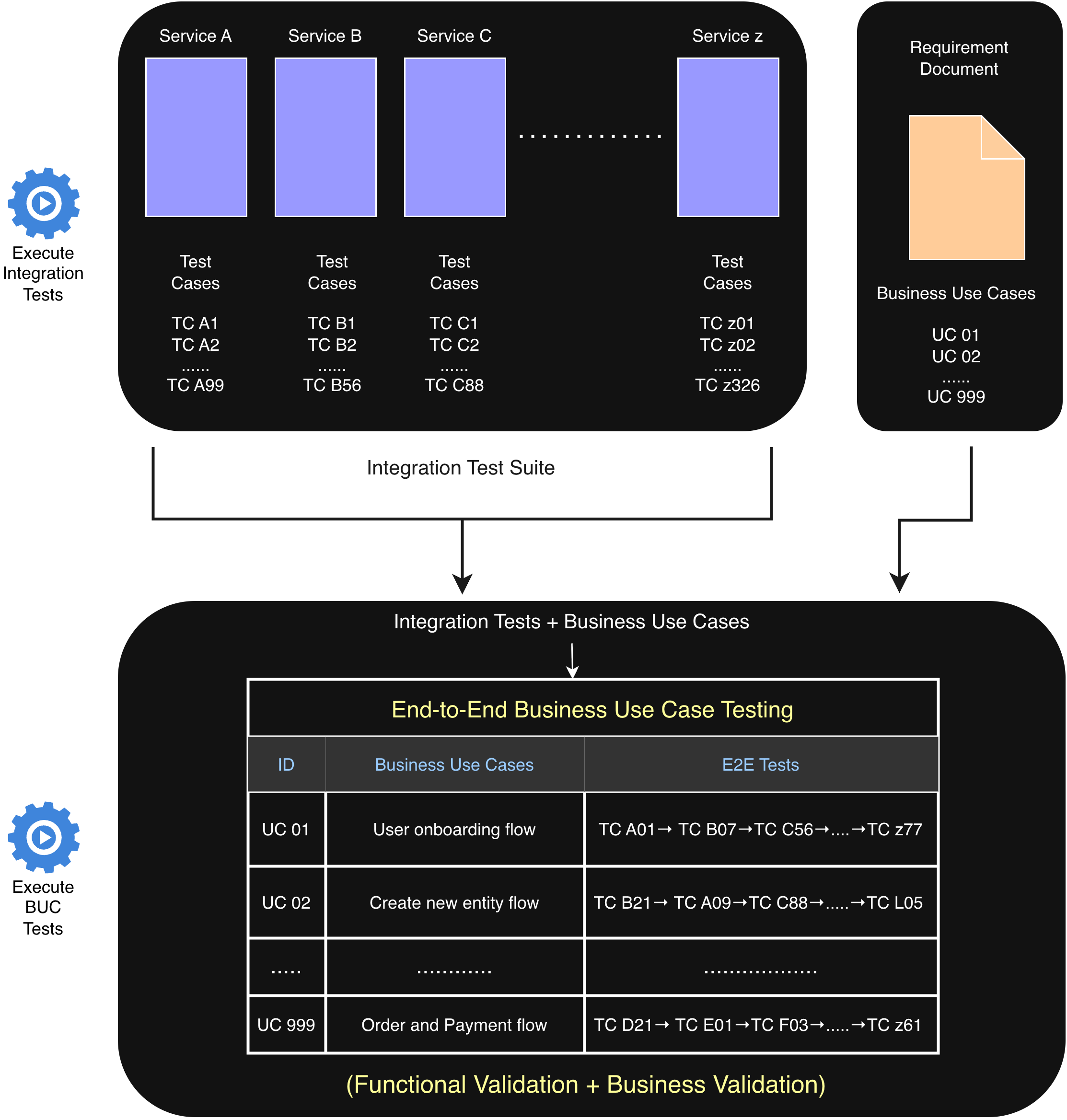
BaseRock provides 2 different types of testing
-
Business Use Case Testing (BUCT):
-
Validates end‑to‑end business workflows like signup, billing, renewals, account management, not just individual endpoints or services.
-
Derives these flows from PRDs, Jira, docs, and domain rules, then keeps them in sync with how the code actually behaves.
-
-
AI‑powered Integration Testing:
-
Auto‑generates integration test suites and data from microservice flows with functional validation.
-
Runs them continuously in CI and test environments, reporting where a flow “works technically” but fails the expected business outcome.
-
Deployment Architecture
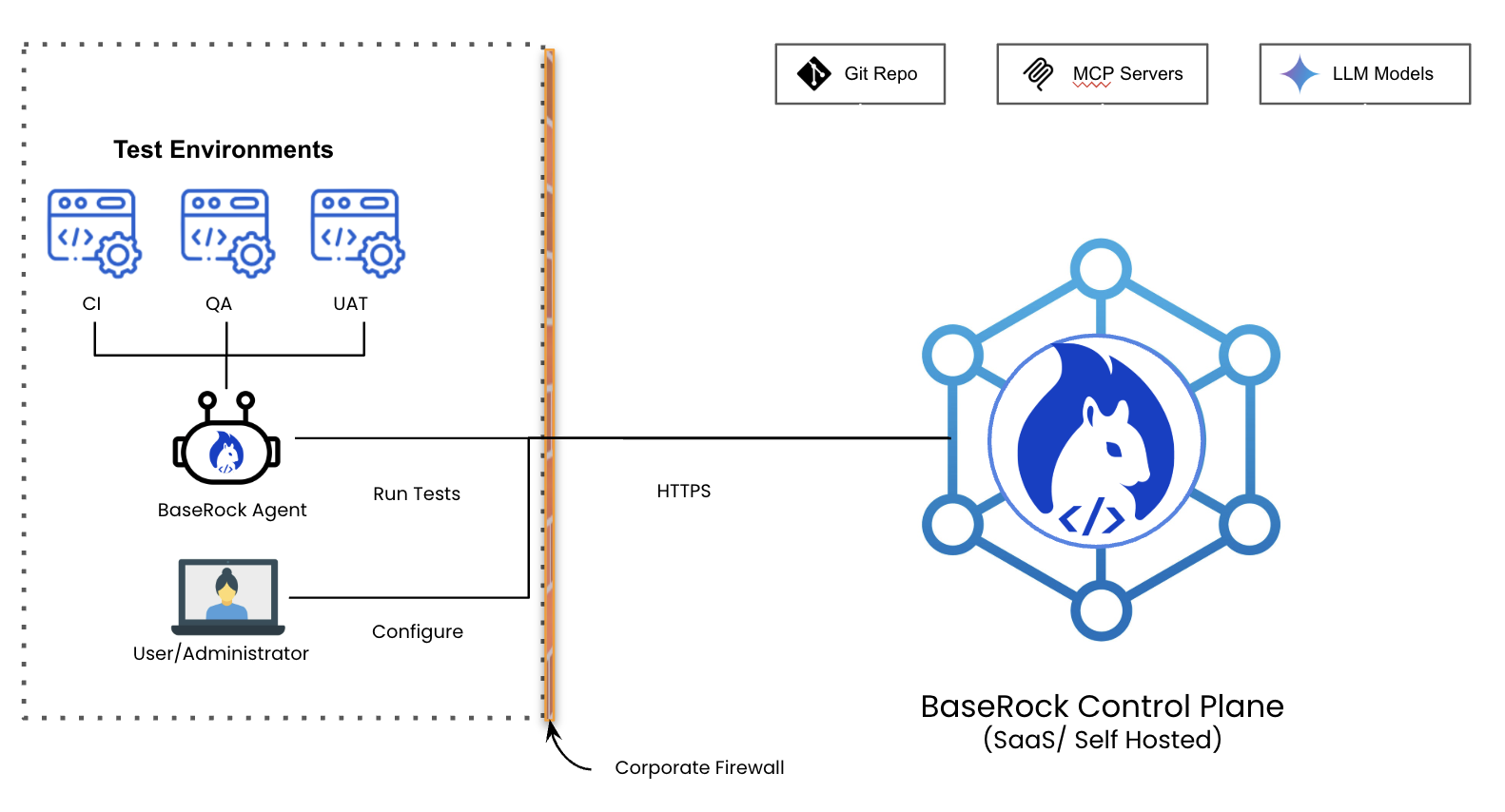
The BaseRock Agentic QA Platform is composed of two primary components — the BaseRock Control Plane and the BaseRock Agent.
BaseRock Control Plane
The Control Plane serves as the central hub for managing the entire QA process. It enables users to: - Onboard services and define testing requirements - Strategize test plans and prepare comprehensive test cases - Integrate with external systems such as source code repositories, MCP Servers, and LLM foundation models
The Control Plane is available as both a SaaS offering and a self-hosted deployment. It includes a web-based UI portal that allows users to easily create connectors, configure environments, and manage automation.
BaseRock Agent
The BaseRock Agent operates within the customer’s environment — typically behind their firewall — and acts as a secure bridge between the Control Plane and local systems.
The Agent is used for: - Connecting to the Control Plane - Receiving test execution instructions and executes test suites on the machine (VPC or physical) - Adding or configuring a service in BaseRock from the development environment - Executing automated test suites as part of the CI/CD pipeline
It can be deployed on: - A developer’s local machine for on-demand testing - A dedicated worker node (physical or virtual) for continuous integration workflows
Check the BaseRock agent usage section for more details.