Business Use Case Testing (BUCT)
The problem with traditional testing
Traditional testing answers: "Did the API return 200?"
BUCT answers: "Did the business outcome actually happen?"
In distributed systems, individual components can all pass their tests while the business workflow silently fails. A payment can be authorised without an invoice being generated. An order can be created without inventory being decremented. These are logical regressions — invisible to unit and integration tests, fatal to the business.
The high-speed risk gap
AI coding assistants are generating code faster than manual tests can keep up. Traditional testing becomes a bottleneck. BUCT acts as a strategic control layer that scales alongside AI-driven development.
BUCT vs traditional testing
| Dimension | Traditional testing | BUCT |
|---|---|---|
| Primary focus | Technical integrity — units, APIs, schemas | Business outcomes — workflows, rules, revenue paths |
| Core question | Is the code right? | Is the business right? |
| Failure mode caught | Crashes, schema errors, status codes | Logical regressions, silent business failures |
| Cross-service coverage | Limited | Full orchestration awareness |
| Scales with AI codegen | No — becomes a bottleneck | Yes — acts as a control layer |
| Risk level | Low-level technical risk | High-level business and brand risk |
Implementing BUCT
In the Service Onboarding section, we learnt how to onboard a service and perform integration testing of your micro-service and discussed how BaseRock tests your application on two levels - Service level and Application level.
Now we will focus on application level, i.e., Business Use Case Testing, that provides double-layered validations - functional layer and business layer.
Below is the user flow to utilise BUCT in test automation.
flowchart TD
  classDef phase1 fill:#eceff1,stroke:#90a4ae,color:#263238
  classDef phase2 fill:#e8eaf6,stroke:#5c6bc0,color:#1a237e
  classDef phase3 fill:#e8f5e9,stroke:#43a047,color:#1b5e20

  A[Login]:::phase1
  A --> B[Create a business flow]:::phase2
  B --> C[Upload BRD or PRD]:::phase3
  C --> D[Extract use cases]:::phase3
  C --> E[Associate a service]:::phase3
  D --> F[Map use case to test case]:::phase3
  E --> F
  F --> G[Generate playbook]:::phase2
  G --> H[Execute]:::phase2
1. BRD ingestion
Go to the Business Flows section from the left panel and create a flow as shown in the screen below.
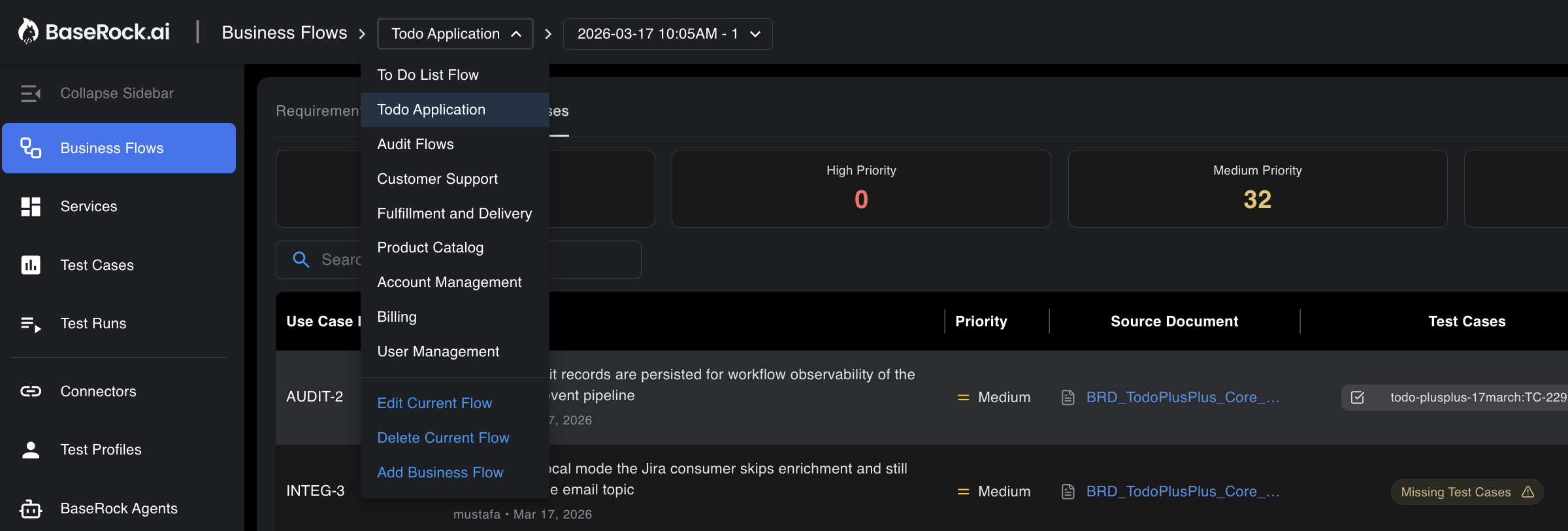
Upload your Business Requirement Documents (.txt or .pdf) in the Requirements tab.
2. AI-driven use case generation
Navigate to the Use Cases tab and click Generate Use Cases. The platform parses the document, and the AI converts abstract business statements into structured, executable test scenarios as shown below.
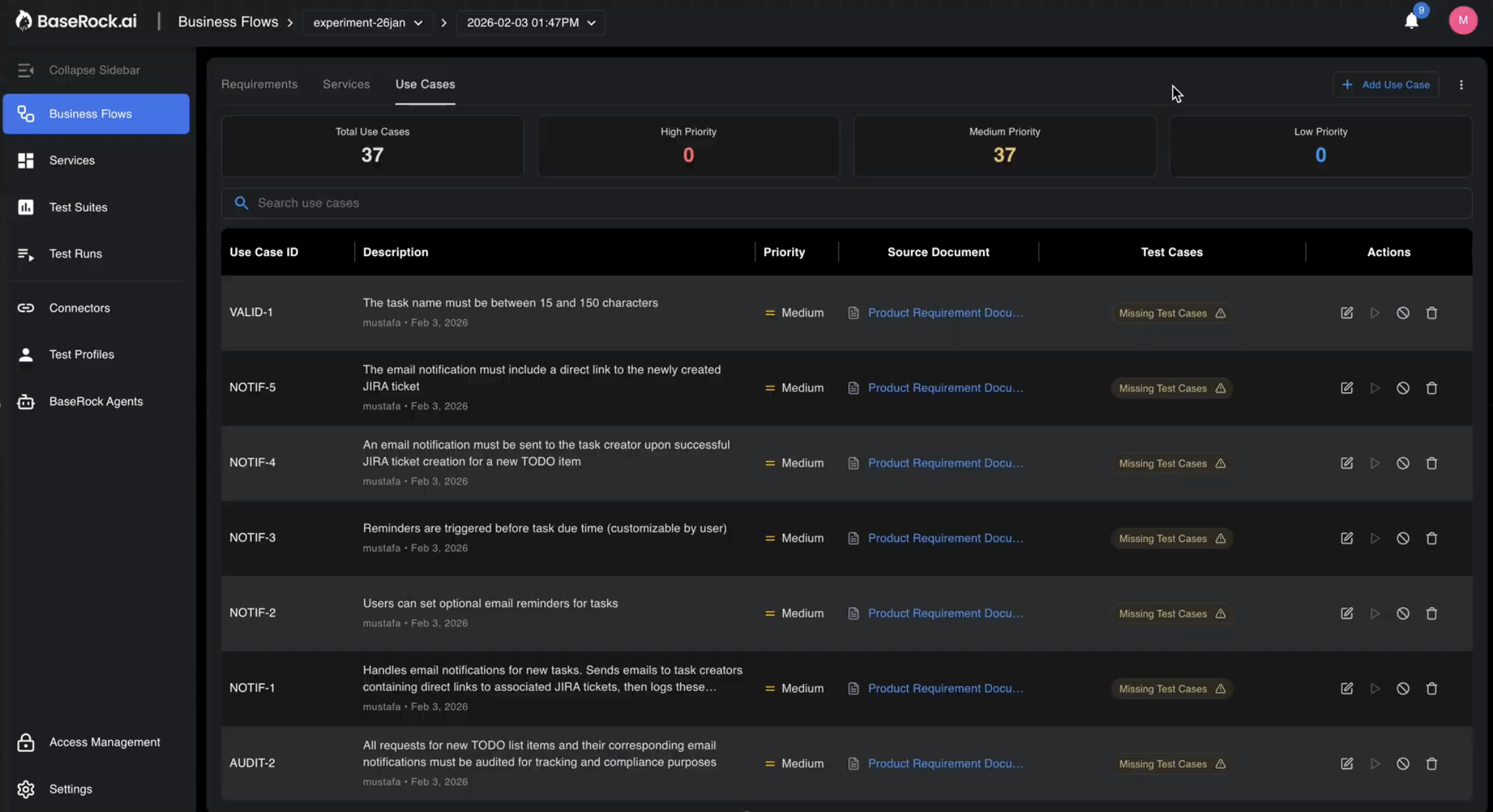
Example
BRD input: "When a customer places an order, it should be fulfilled and invoiced."
BUCT output: A multi-step flow validating payment authorisation, inventory decrement, invoice generation, email dispatch, shipment trigger, and audit logging.
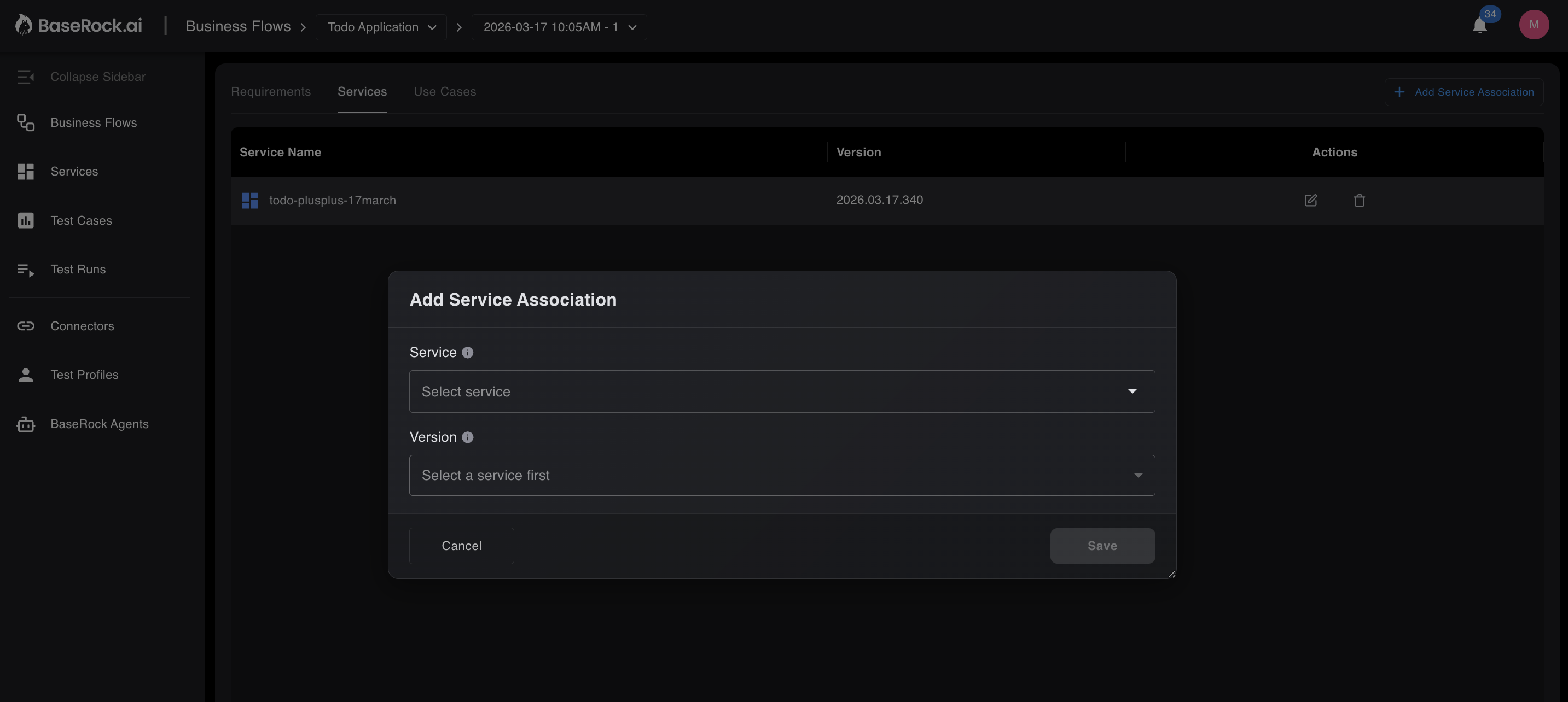
3. Associate a service
For BUCT to know the details of the actionable endpoints, the user must add an existing onboarded service under the Services tab within the Business Flow.
To learn service onboarding in detail check here.
4. Use case to test case mapping
Click the three dots in the top-right corner and select Map Use Cases to Test Cases. This will generate test cases for the respective use cases. If the tests cannot be produced, they will be marked as missing test cases, showing the coverage gap between the requirement and the service under test.
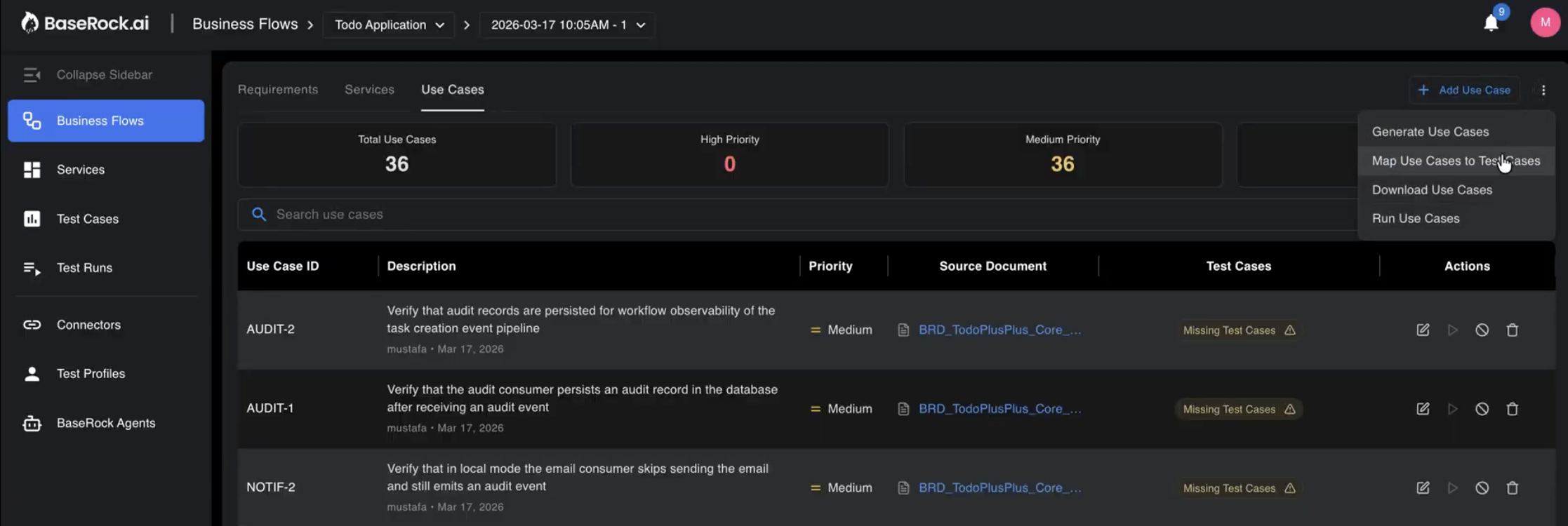
If the test cases were already generated inside the service then extracted business use cases will be mapped to the relevant test cases — ensuring full cross-service coverage, not just endpoint-level coverage.
5. Test cases
These test cases are end-to-end tests which can be executed based on the selected playbook which carries all the steps present in the complete flow in simple english. Users can select any existing playbook from the dropdown and add some business specific verifications at the end under "Verification Steps" prompt area.
Note
If you are interested in just integrations tests and not end-to-end, refer to this section: Integration Tests
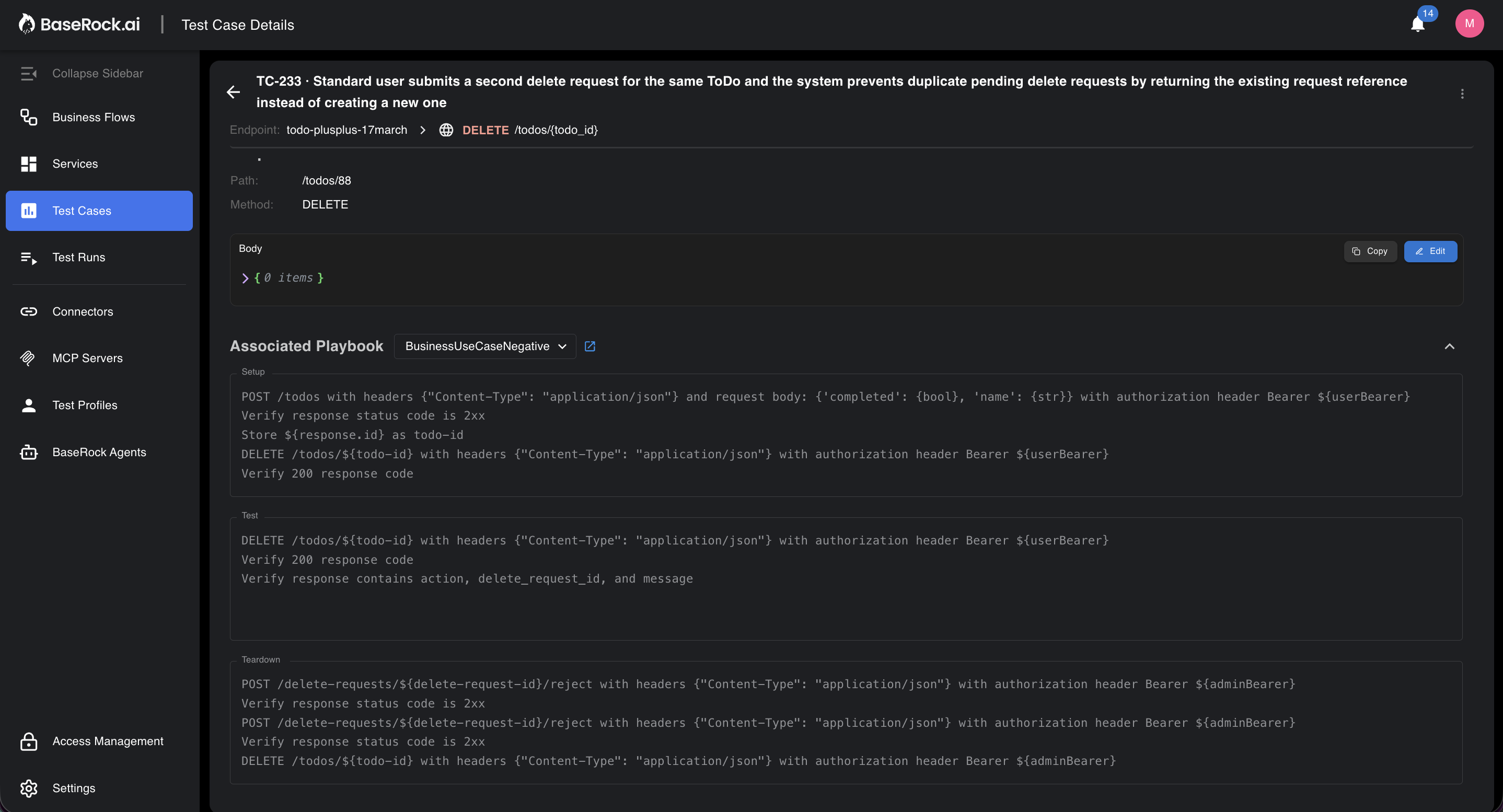
6. Playbook generation
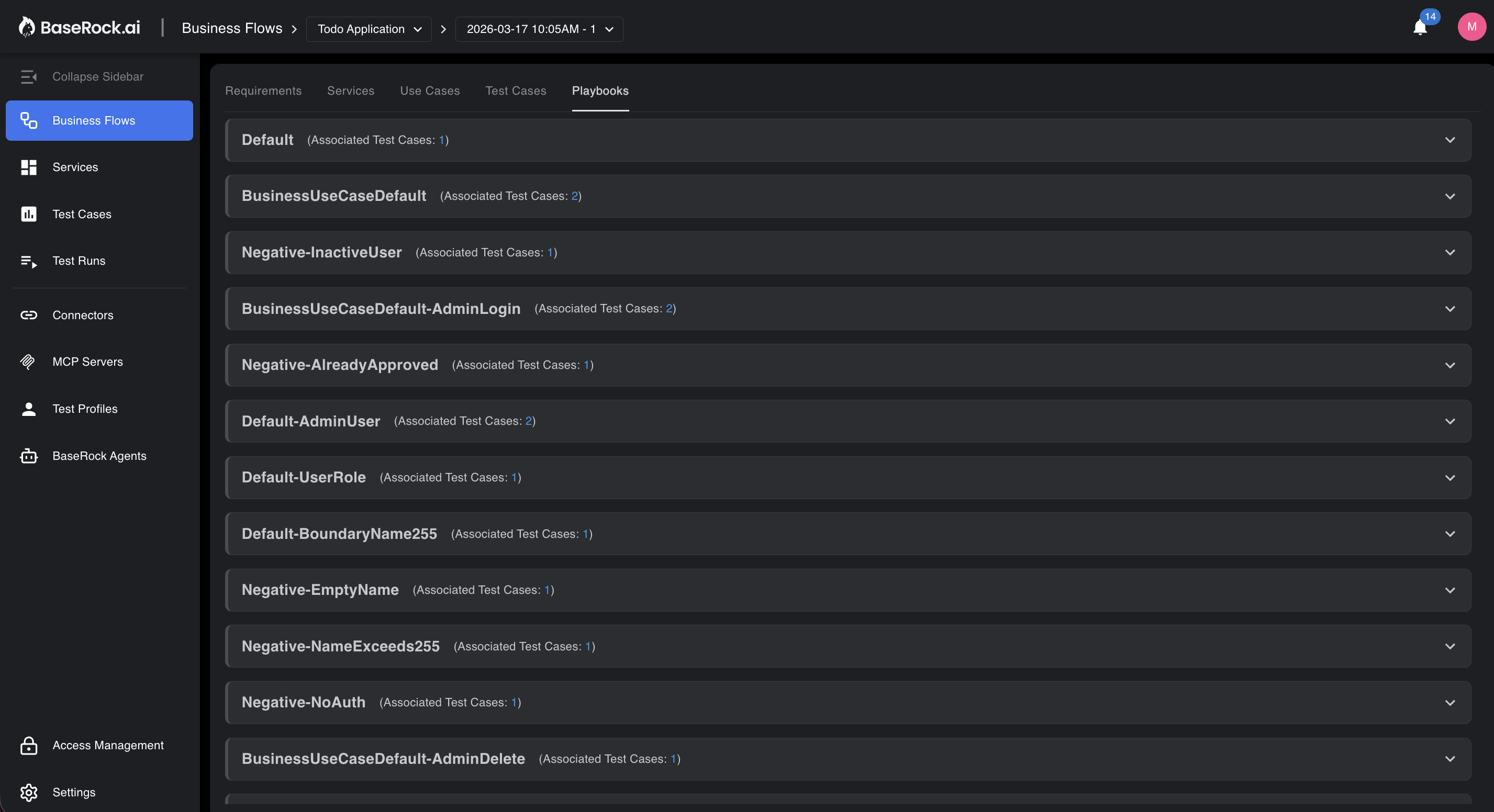
Business use case level playbooks get automatically generated once the use case to test case mapping is complete.
Each playbook orchestrates a complete flow across all the microservices involved in the business use case — eliminating siloed, service-by-service validation. Rather than testing services in isolation, a playbook sequences actions end-to-end: from the first user-facing interaction through every downstream system required to fulfil that business outcome based on the context ingested by BaseRock either via BRD or MCP server integration of tools like Confluence or Notion.
This means playbooks validate not just whether each service functions correctly on its own, but whether the complete business journey delivers the expected result — start to finish.
BaseRock generates multiple playbooks per business use case, each targeting a distinct testing scenario:
- Happy path — the expected, successful completion of the workflow
- Edge cases — boundary conditions and uncommon but valid inputs
- Negative cases — invalid inputs, missing data, and error-handling paths
Users can then open and edit any playbook using natural language, based on their domain-specific testing plan.
E-commerce: Place an order
Consider a checkout flow spanning three services — Account, Order, and Payment.
A BUCT playbook for the "Place an Order" use case sequences the entire journey in a single execution:
- Authenticates the user via the Account service
- Creates an order via the Order service
- Processes payment via the Payment service
- Validates the end-to-end outcome — order confirmed, payment charged, inventory updated
Separate playbooks cover scenarios such as a payment failure, an out-of-stock item, or an unauthenticated checkout attempt — each as a distinct, independently executable flow.
7. Agent-based execution
Once mapping is done and playbooks and configurations are set, users can start testing with the help of the BaseRock agent.
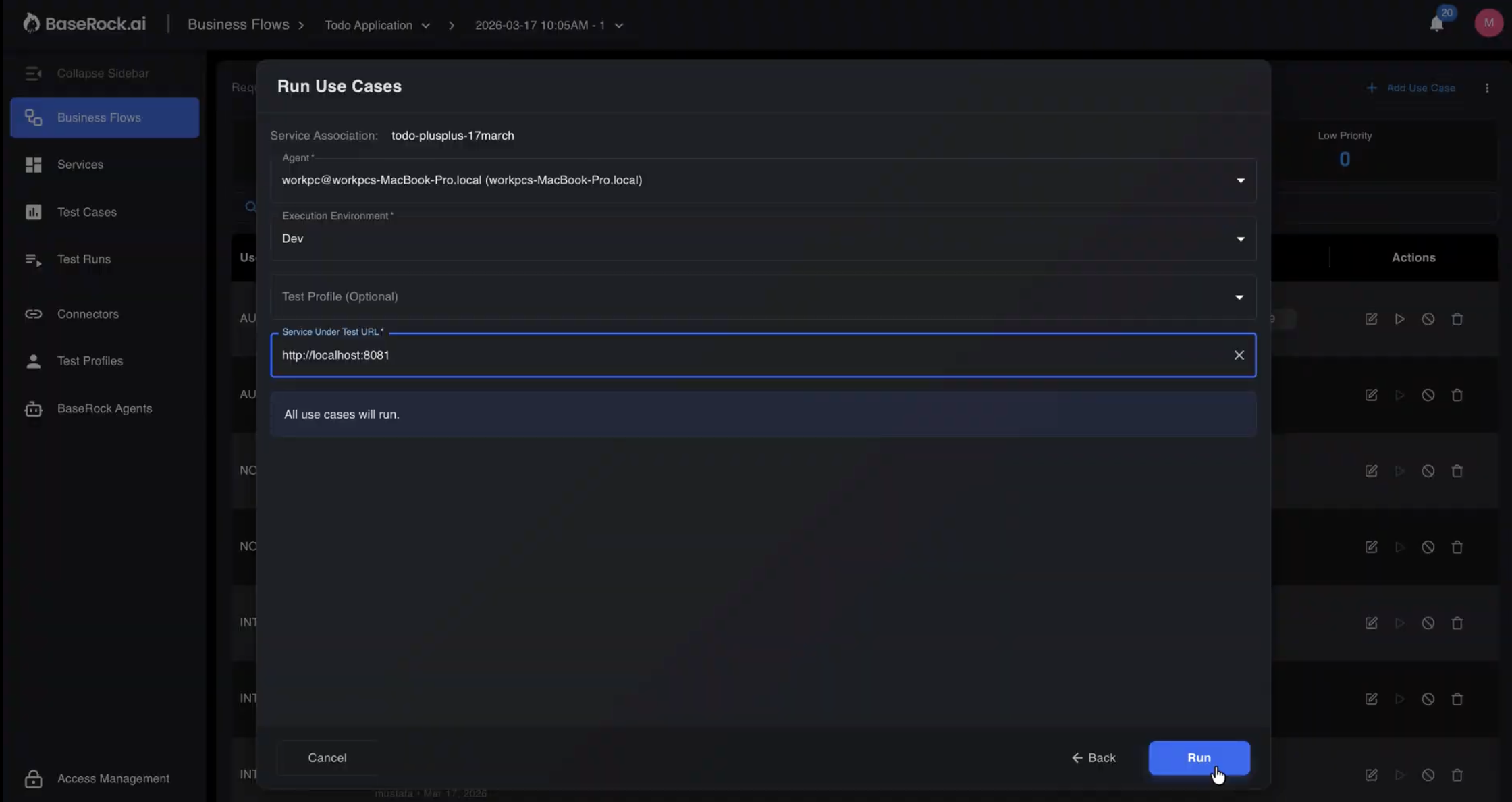
The BaseRock Agent executes deterministic end-to-end flows inside your CI/CD pipeline. Works across microservice and monolithic architectures.
To learn more about the BaseRock agent, refer to the BaseRock Agent Usage section.
8. Use case execution result
Once test execution is triggered by user, thay are navigated to the test run result page that has 2 tabs - Test Case View and Use Case View as shown in the below screen
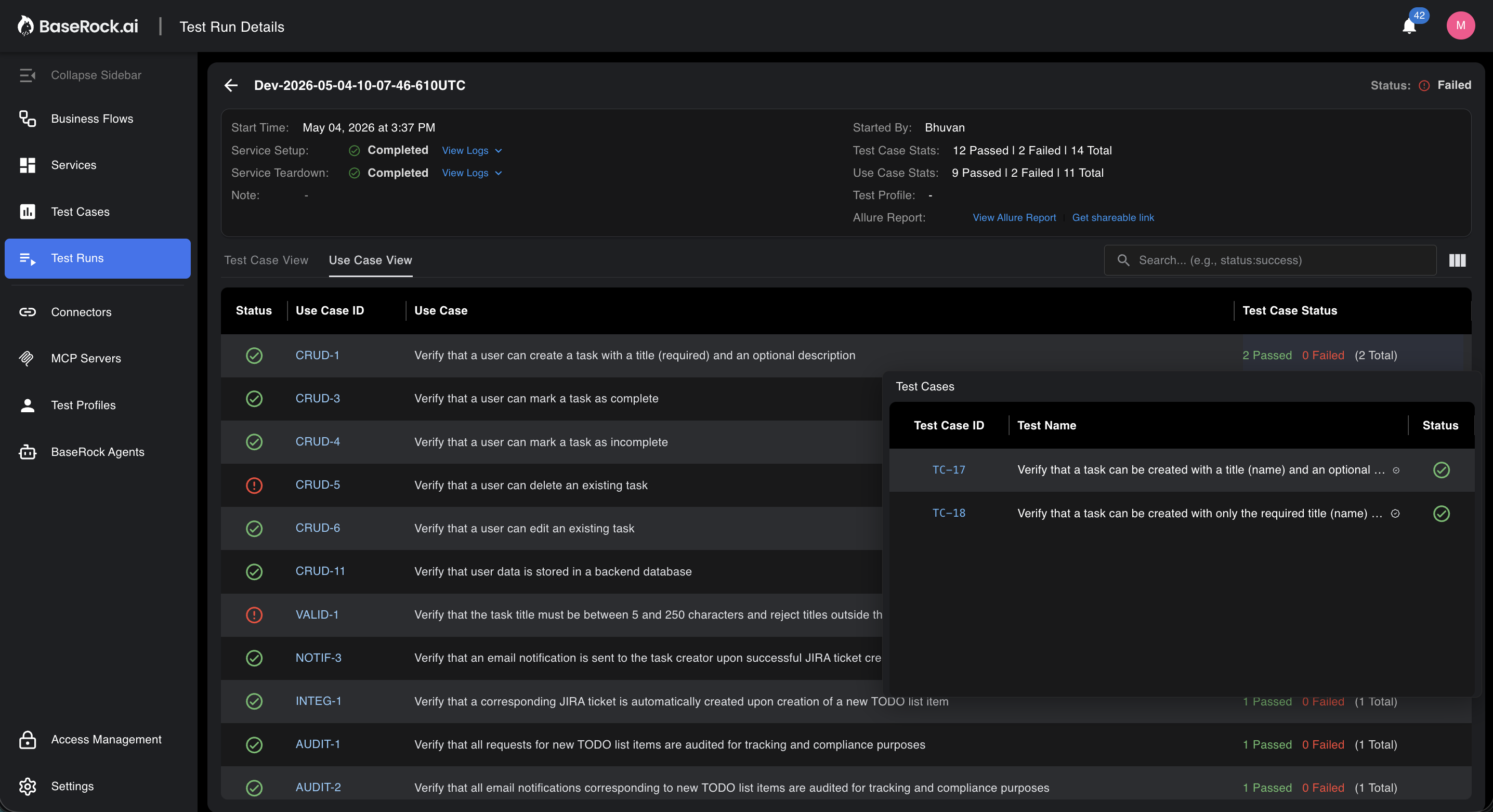
In the Use Case View tab users can hover over any use case to see the exact set of test cases corresponding to it and their respective result.
BUCT Example for better understanding: eCommerce order placement
PRD statement: "When a customer places an order, it should be fulfilled and invoiced."
POST /ordersreturns HTTP 200- Response schema matches spec
- Required fields are present
It does not validate whether the business outcome actually happened.
- Payment gateway authorisation succeeded
- Inventory decremented by correct quantity
- Invoice was generated
- Confirmation email was dispatched
- Shipment workflow was triggered
- Audit logs recorded with correct timestamps and user attribution
Step 1 — Order creation
- Confirm order ID is generated
- Validate status is initialised correctly
Step 2 — Payment
- Confirm payment authorisation
- Ensure
transaction_status = SUCCESS - Assert no duplicate charges
Step 3 — Inventory
- Verify stock reduced by purchased quantity
- Assert no negative inventory state
Step 4 — Notifications
- Confirm confirmation email trigger
- Validate email contents — Order ID, pricing, delivery address
Step 5 — Shipping
- Confirm shipment record creation
- Validate correct warehouse assignment
Step 6 — Audit & compliance
- Confirm transaction log entry
- Validate timestamp and user attribution
Architecture
BUCT runs on two components:
-
Control plane
- Parses source code and PRDs
- Generates business use cases
- Maps requirements to test coverage
-
Agent
- Executes end-to-end business flows
- Handles setup and teardown per playbook
- Validates runtime-generated values (dynamic IDs, timestamps)
Why the split?
The control plane (intelligence) stays separate from the agent (execution), making BUCT portable across any CI/CD system.
Key capabilities
-
AI-driven flow generation
Use cases generated directly from PRD text — no manual scripting.
-
Cross-service orchestration
Validates workflows spanning multiple services, not just individual endpoints.
-
Playbook composability
Reusable, version-controlled playbooks reduce duplication across test suites.
-
Deterministic execution
Consistent results for AI-generated code across environments.
-
Revenue-path confidence
Prioritises validation of business-critical flows over low-level noise.